

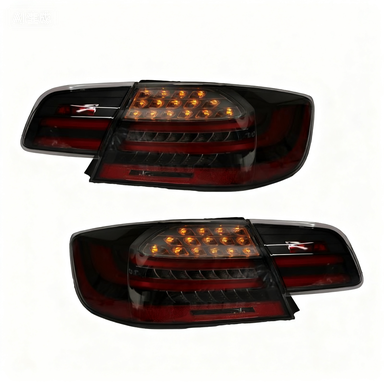
A replacement taillight assembly must match the vehicle’s body configuration, mounting points, electrical connections and required rear-light functions. For LED upgrades and modified assemblies, buyers also need to confirm how each lighting function operates and whether the product is suitable for the destination market. A similar appearance does not guarantee a correct fit.
1. Build an exact vehicle fitment record
Taillight designs can vary between vehicle generations, body styles, facelift versions and trim levels. Even within the same model range, coupe, sedan and touring versions may use different rear lamp shapes and mounting arrangements.
Include the following information in your RFQ:
- Vehicle make, model and generation
- Production year and facelift version
- Body style and trim level
- Destination market
- Left-hand or right-hand taillight, or a complete pair
- OE part number, if available
- VIN or chassis code where appropriate
- Photos of the original taillight, rear housing and connector
For example, the product featured in this guide is listed for the 2006–2011 BMW 3 Series E92, including 330, 335 and M3 applications. Buyers should still confirm the exact vehicle version and original part reference before ordering rather than assuming that every E92 configuration uses an identical assembly.
2. Identify the correct taillight configuration
Before requesting a quotation, clarify whether you need a complete taillight assembly, an outer lamp, an inner trunk-mounted lamp or another specific component.
| Component / Configuration | What Buyers Should Confirm |
|---|---|
| Complete Taillight Assembly | Whether the quotation covers the full lamp unit |
| Outer Taillight | Compatibility with the vehicle’s rear quarter panel |
| Inner Taillight | Compatibility with the trunk lid or tailgate |
| Left / Right Lamp | Correct vehicle side and matching design |
| Pair Set | Whether both sides are supplied together |
| Modified Taillight | Differences from the original design and required installation details |
A product image may show a complete set, but the actual quotation should state exactly what is included. Confirm whether bulbs, LED modules, drivers, wiring harnesses, adapters or other accessories are supplied.
3. List every required lighting function
A taillight assembly may combine several functions in one housing. These can include tail lamps, brake lights, turn signals, reversing lights and rear position lights.
For LED replacement or modified taillights, identify each function separately instead of relying on a general description such as “LED taillights.”
| Lighting Function | Details to Verify | Common Sourcing Risk |
|---|---|---|
| Tail / Position Light | Light pattern and operating mode | Incorrect or inconsistent illumination |
| Brake Light | Brightness and activation behavior | Brake function does not operate as expected |
| Turn Signal | Standard or sequential operation | Incorrect signal behavior or wiring |
| Reversing Light | Position and operating function | Missing or incompatible reversing function |
| Additional LED Features | DRL-style or decorative lighting, if applicable | Feature requires wiring or control not included |
The featured BMW E92 assembly is described as having LED sequential turn signals and reversing lights. However, buyers should request confirmation of the complete lighting-function list and the exact operating configuration before placing an order.
4. Check electrical connections and installation compatibility
A taillight can have the correct exterior shape but still be incompatible with the vehicle’s electrical system.
Before approving a replacement, confirm:
- Connector shape and pin count
- Pin assignment and wiring functions
- Whether an adapter harness is required
- Whether the assembly includes LED drivers or other control components
- Whether the original vehicle wiring can be retained
- Whether coding or additional installation procedures may be required
For modified LED assemblies, do not assume that the original connector guarantees plug-and-play installation. Ask the supplier to clarify the connection requirements for the exact vehicle version.
If the product is intended for a wholesale replacement-parts program, documenting these details can also help reduce installation questions and returns from downstream customers.
5. Confirm appearance, lens and housing quality
Taillights are visible exterior components, so appearance consistency matters alongside functional performance.
| Inspection Area | What to Check |
|---|---|
| Lens | Scratches, cracks, surface clarity and visible defects |
| Housing | Deformation, damage and overall construction |
| Lens-to-Housing Joint | Uneven gaps or visible assembly defects |
| LED Appearance | Consistent arrangement and illumination |
| Color and Finish | Consistency between left and right lamps |
| Mounting Points | Position, shape and condition of tabs and brackets |
| Product Identification | Part reference, vehicle application and side marking |
For a pair of taillights, compare both units together. Differences in lens color, internal appearance or LED arrangement can be noticeable after installation.
6. Verify road-market requirements
Rear lighting requirements can vary by destination market. Buyers should confirm the applicable rules for the intended country before approving a modified or LED taillight assembly.
Relevant points may include:
- Required rear-light and turn-signal functions
- Permitted lamp colors
- Light visibility and positioning
- Sequential turn-signal requirements, where applicable
- Required approval markings or supporting documents
Do not assume that a product suitable for one market automatically meets the requirements of another. If a specific certification or marking is required, state it in the RFQ and request evidence for the exact product configuration.
7. Inspect a sample before bulk ordering
For importers and distributors, sample inspection is a practical way to check product condition and installation compatibility before committing to a larger quantity.
| Inspection Area | What to Verify |
|---|---|
| Vehicle Fitment | Model, year, body style and OE reference |
| Physical Fit | Housing shape, mounting points and alignment |
| Electrical Connection | Connector engagement and wiring compatibility |
| Lighting Functions | Tail, brake, turn-signal and reversing lights |
| Sequential Signals | Correct activation sequence and operation |
| Appearance | Lens condition, finish and left/right consistency |
| Included Components | Drivers, adapters, harnesses and accessories |
| Identification | Product labels and side markings |
Where possible, test the sample on the intended vehicle or an appropriate test setup. Record any differences between the original lamp and the replacement before approving the product for a larger order.
8. Confirm packaging and shipping requirements
Taillight assemblies contain exposed lenses and mounting tabs that can be damaged during handling and transportation.
Before ordering, clarify:
- Individual protective packaging for each lamp
- Non-abrasive protection for the lens surface
- Internal cushioning around the housing and mounting tabs
- Protection against movement inside the carton
- Left/right identification and product labels
- Carton quantity and shipping arrangement
For wholesale shipments, packaging should be suitable for the product dimensions, order quantity and transportation route. Buyers should also agree on how visible damage will be documented when goods arrive.
9. Prepare a complete taillight RFQ package
A complete RFQ helps suppliers identify the correct assembly and reduces repeated clarification.
- Vehicle make, model, generation and production year.
- Body style, trim level and destination market.
- OE part number or VIN, where available.
- Left taillight, right taillight or complete pair.
- Original lamp photos and connector photos.
- Required tail, brake, turn-signal and reversing-light functions.
- Standard or sequential turn-signal configuration.
- Electrical connection and included-component requirements.
- Required market conformity documents or markings.
- Order quantity, packaging and destination country.
10. Questions to resolve before approval
Does an LED taillight assembly support sequential turn signals?
Not every LED taillight has a sequential signal function. Confirm the required lighting configuration and ask for a demonstration or sample test of the signal operation.
Can modified taillights be installed without changing the original wiring?
This depends on the vehicle’s electrical architecture and the replacement assembly. Confirm connector compatibility, wiring requirements and whether adapters or additional components are needed.
Should I order a complete pair or individual lamps?
This depends on the product configuration and repair requirement. If only one side is being replaced, confirm that the new lamp matches the existing unit in appearance and function. For modified lighting upgrades, a matched pair may provide a more consistent result.
What information should I provide when requesting a quotation?
At minimum, provide the vehicle model, production year, body style, OE reference if available, required lamp side, product photos and quantity. For LED modifications, also specify the lighting functions and connector requirements.
Prepare Your Taillight Sourcing Request
Explore our replacement taillight range, review the 2006–2011 BMW 3 Series E92 LED sequential taillight assembly, or contact our Auto Parts team with your vehicle details, reference numbers and product requirements.
