

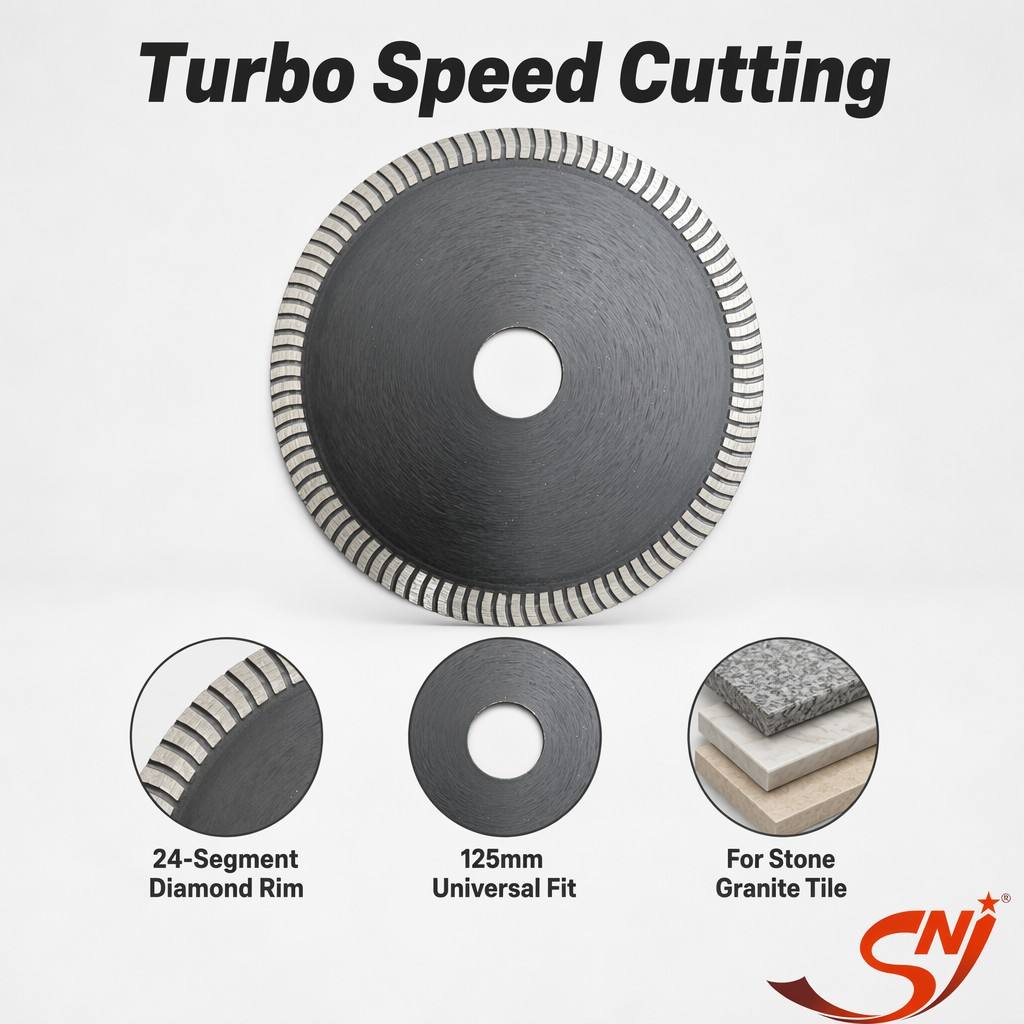
Selecting a diamond saw blade is a system-matching decision, not simply a diameter choice. The workpiece, machine, cutting method and required edge quality all influence blade performance. A technically complete request for quotation reduces trial-and-error, prevents incompatible combinations and makes supplier comparisons more meaningful.
1. Start with the material, not the blade name
Granite, marble, porcelain tile, ceramic tile, engineered stone and cured concrete do not behave in the same way during cutting. Their abrasiveness, hardness and tendency to chip affect the diamond concentration, bond and rim design that should be considered.
Use the most specific material description available. For example, “porcelain floor tile” is more useful than “tile,” while “reinforced cured concrete” is more useful than “construction material.” If several materials will be cut, state the approximate share of each rather than asking for a universal blade without context.
| Application detail | Why it matters | Information to provide |
|---|---|---|
| Material | Influences bond and rim selection | Exact stone, tile or concrete type; reinforced or non-reinforced |
| Cut objective | Changes the balance between speed and finish | Fast production cut, clean visible edge, slotting or occasional site work |
| Cutting method | The blade must be rated for the intended method | Wet, dry or both; continuous or intermittent use |
| Machine | Determines interface and operating limits | Machine type, model, spindle speed and power |
| Dimensions | Controls fit and achievable cutting depth | Diameter, bore/arbor, kerf and any flange constraints |
2. Match the rim design to the cutting priority
Rim style is an important visual clue, but it should not be treated as the complete specification. Diamond grade, concentration and bond formulation also affect behavior. Always evaluate the complete blade recommendation for the intended material and machine.
Continuous rim
A continuous cutting edge is commonly considered when reducing chipping on tile and similar finish-sensitive materials is the priority. Feed rate and cooling still need to be appropriate for the blade and workpiece.
Turbo rim
A turbo profile is often selected to balance cutting speed and edge quality across stone and masonry applications. Segment geometry varies between designs, so confirm the recommended material range rather than relying on the word “turbo” alone.
Segmented rim
Segmented blades are commonly used where debris clearance and cooling are important, including many concrete and masonry tasks. The segment specification must still match the aggregate, reinforcement and operating method.
3. Confirm machine compatibility before ordering
The machine name alone is not enough. Record the blade diameter accepted by the guard, bore or arbor size, flange arrangement, no-load spindle speed and available power. The blade’s marked maximum operating speed must never be lower than the machine speed.
- Required outside diameter and permitted cutting depth
- Exact bore/arbor diameter and any reducer-ring requirement
- Machine RPM and blade maximum RPM
- Handheld saw, angle grinder, bridge saw, tile saw or floor saw
- Rotation direction and mounting arrangement
- Guard and flange compatibility
4. Specify wet or dry cutting correctly
Use a blade only in the operating mode for which it is rated. Wet cutting can help cool the cutting zone and control dust, but the machine must also be designed for that method. Dry cutting may require intermittent passes and suitable dust controls according to the blade and machine instructions.
Cutting stone, concrete and some tile can generate respirable crystalline silica. OSHA identifies wet methods and local exhaust ventilation as primary engineering controls for many silica-generating tasks. Its guidance also stresses continuous water delivery where a wet method is specified, inspection of the blade, and operation according to the equipment manufacturer’s instructions. See the OSHA crystalline silica overview and the OSHA saw dust-control fact sheet.
5. Define how the result will be evaluated
A useful trial has a measurable acceptance method. Instead of asking only whether a blade is “good,” identify the result that matters to the operation.
| Evaluation area | Example of a usable criterion |
|---|---|
| Edge finish | Acceptable chip size on the visible face |
| Cutting productivity | Cut length or number of pieces under a defined machine setup |
| Blade behavior | No abnormal vibration, glazing or segment damage |
| Dimensional result | Kerf consistency and straightness within the buyer’s process tolerance |
| Operating condition | Recorded material, RPM, feed method, depth per pass and cooling method |
6. Use a complete RFQ checklist
For a comparable quotation, send the following information with photos of the workpiece and machine label where available:
- Material name, thickness and whether it contains reinforcement.
- Machine type, model, RPM and power.
- Blade diameter, bore/arbor and preferred kerf.
- Wet or dry operation and expected duty cycle.
- Required edge quality and production priority.
- Current blade type and the problem to be improved.
- Trial quantity, packaging needs and destination market.
7. Safety checks belong in the purchasing specification
A suitable blade still requires correct installation and operation. Inspect the blade before use, follow the marked rotation direction, use the machine guard, keep within the stated speed limit and follow the blade and machine manufacturers’ instructions. Operators should use the controls and personal protective equipment required by the workplace risk assessment and local regulations.
Discuss a blade for your application
Review our diamond saw blade range, see a 125 mm turbo blade example, or send your application details for a specification discussion.
